
Not Here — Reading Notes on The Depth of Silence
Lately, with a little more time on my hands, I have been reading not only photography books but also books on painting and art criticism. Whenever I read criticism about photography, I find myself wondering whether thinking about the aesthetics of an image solely from the perspective of photography leads us too easily into a narrow space. The history of photography and photographers’ own writings can greatly expand the meaning of the “photograph” itself. Yet if we spend too long searching for meaning within that framework, our thinking can also settle into fixed patterns.
Take the influence of Japanese photographers on Chinese photography in recent years. When we look at photographic history—from The Americans to Farewell Photography—we are inevitably led to think about photography’s subjectivity and expressive potential. But this approach can be dangerous. It can turn into a familiar formula, allowing the critic to slip unknowingly into a comfort zone. After reading a number of books on shishashin, or “I-photography,” many of the concepts in my mind came from the Japanese tradition of photography centred on the self. As a result, when looking at the work of others, I would easily impose the idea of “self-expression” upon it and arrive at a partial reading.
Fortunately, I have temporarily stepped away from photography, which has allowed me to look at it from a certain distance. It then occurred to me that painting might offer something missing from the way I read and think about photographic criticism. So I chose a book that was not especially long but rich in substance: The Depth of Silence.
01 — On Hopper’s Paintings
There is a captivating sense of mystery in Edward Hopper’s paintings. What he depicts belongs neither to the traditional realm of the divine nor to the rationality of forms broken down into abstraction. To me, his work feels more like a real-world version of Surrealist painting—of Magritte, for example. Magritte’s paintings reveal the possibilities of an imagined world inside the mind; Hopper’s paintings may be what emerges when such a world of fantasy takes form within reality.
In any case, I was not trained in art, nor have I read extensively in art history. I am therefore not yet able to interpret and critique a painting entirely on my own. That is why this book has been so important to me.
02 — Gas
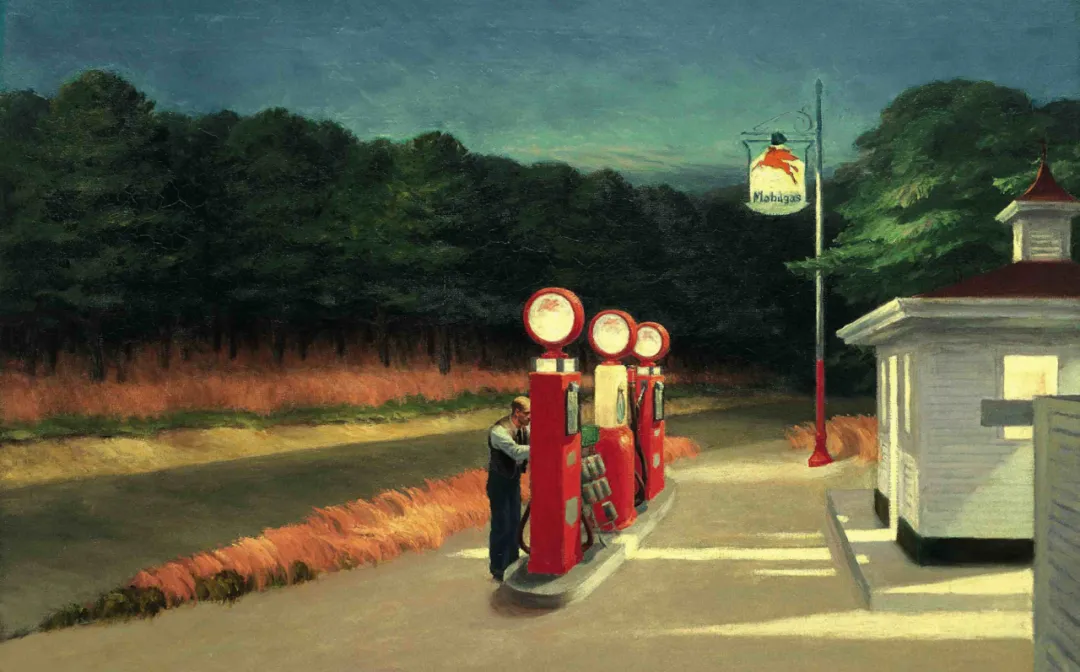
In Gas, the dark trees stand high, poised to swallow the viewer—or any pedestrian walking along the stretch of road between them and the filling station. Yet they are also merely an ominous backdrop to this small station, its lights glowing in vain, and to the attendant at work. What draws our attention is the little station itself, and the driveway enclosed by the fuel pumps on one side and the small white building on the other. This bounded passage leaves us wondering: as travellers and as viewers, where are we supposed to go?
—The Depth of Silence
The illuminated Mobilgas sign bears a small red winged horse. There is something ironic about it, as if it only heightens the idea of escape—and the futility of escaping the fate of ordinary mortals like us. The station attendant is still at work, but his presence does nothing to ease the tension stretched across the scene before us. Even as he works overtime, he can only try to postpone the arrival of night and prolong the daylight already gone.
—The Depth of Silence
When I look at Gas, I feel an unusual sense of mystery. It does not come directly from the scene itself, but from a question: why does such an “ordinary” moment from everyday life make me feel something so different? The image is extraordinarily simple, even commonplace, yet as viewers we seem to be guided towards a hidden side of life that would otherwise go unnoticed.
“The streets and roads are empty of cars. There is no one here with whom to share what we see, and no one has been here before us. What we experience will be ours alone. The exile of travel, the loss that accompanies it, and the fleeting sense of absence gather in the air and stir beneath the surface.”
I have never been to the place in the painting, nor have I lived through the experience it suggests. Yet the fading light, the cool and restrained illumination, and the insignificance of a weary human figure within the vastness of nature all leave me breathless.
What is frightening is that this suffocation cannot be shared, because I cannot describe such elusive emotions to anyone else. I cannot talk to a friend about the feeling of staring blankly at the rain. I cannot talk about a song from some afternoon twenty years ago suddenly playing on television, nor about the taste of fried chicken from the restaurant opposite my school on an autumn afternoon. These thoughts, sounds, and tastes are insignificant and almost impossible for others to share. Yet Hopper’s paintings convey them with remarkable clarity.
03 — Cape Cod Evening
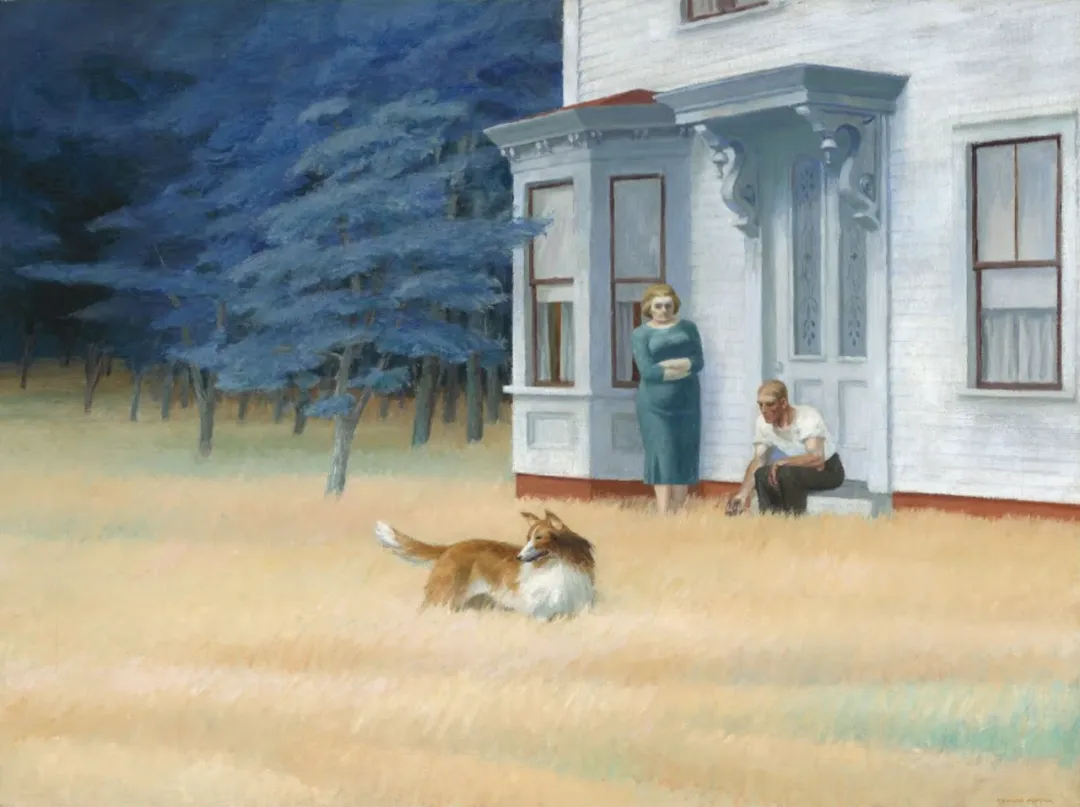
A woman stares into the distance. Her husband tries to attract the dog’s attention, while the dog looks towards something beyond the lower-left edge of the painting. The man’s attempt receives no response. It suggests a family held together only by a strained effort to remain attentive, whose eventual collapse is merely a matter of time.
—The Depth of Silence
Yet the movement it sets in motion continues, carried by the uneven line of the woods before finally dissolving into a prophetic darkness. “Evening,” a mild and plainly descriptive word, produces a disturbing and powerful resonance. At first glance, the painting seems perfectly ordinary and peaceful—a married couple playing with their pet. But that impression dissolves into the impending collapse of the building they inhabit. The house gives way to the woods, while the harmony of the family is entrusted to the wandering attention of a dog.
—The Depth of Silence
Many figures in Hopper’s paintings face towards something outside the frame, making us wonder: what exactly is out there? At the same time, the angle of the light is often strikingly deliberate, usually arriving from the direction opposite the one the figure is facing.
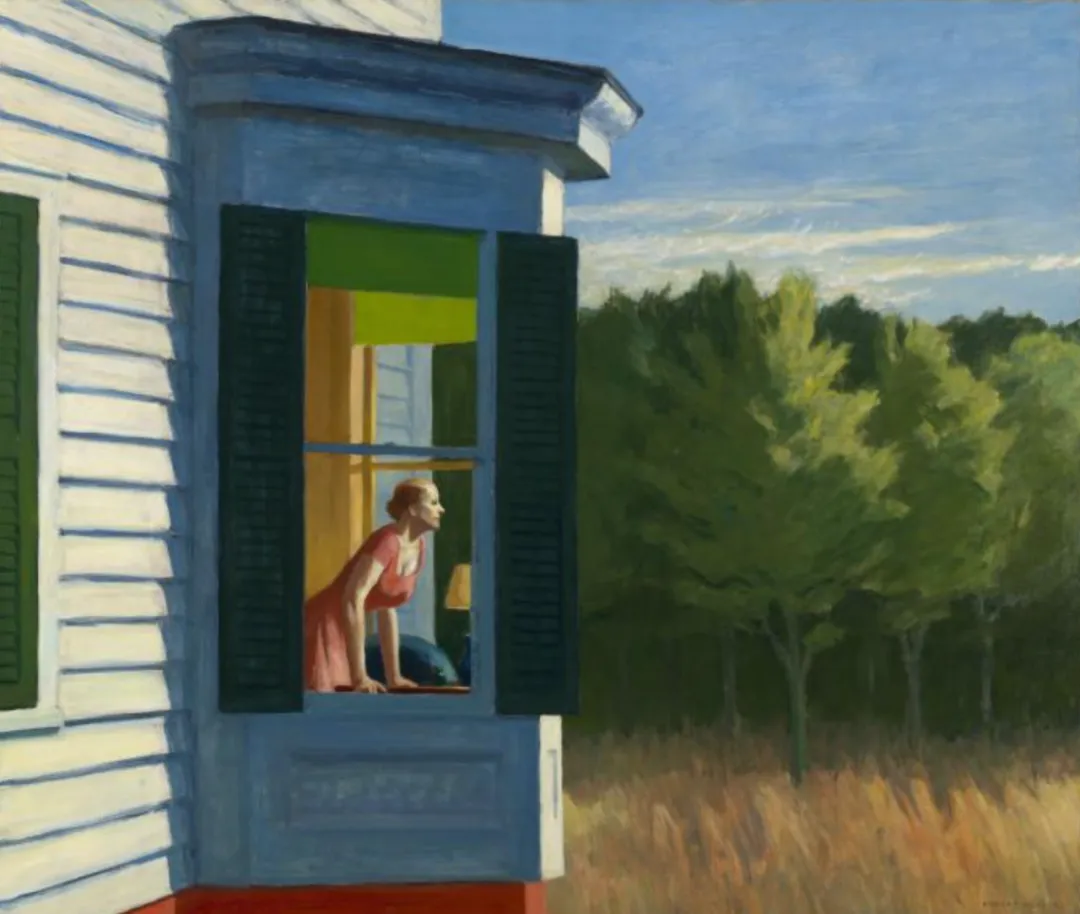
This handling of light always sets the imagination in motion. The figures appear idle, listless, or calmly suspended in some natural state, as though a camera had “accidentally” captured an ordinary moment within an unnatural situation. Every object is rendered objectively, yet when brought together they seem to describe something unnatural taking place in real life. At times the effect feels almost comic, but more often it is profoundly desolate.
Although the figures face a beam of light, it can neither guide nor warm them. Instead, it carries a cool and austere severity. We can never know what is happening outside the frame, but we sense that absurd events continue to unfold inside the still image.
04 — Landscape Photography and New Topographics
After looking at Hopper’s paintings and reading the book’s analysis and commentary, I was left with an inexpressible sense of loss. By the time I reached this point, I could no longer find the right sentence. I had begun the essay full of ambition, but after closely analysing and repeatedly looking at several paintings, I found myself caught once again in that same feeling, unable to break free. Even my hands suddenly felt heavy on the keyboard.
Hopper’s paintings made me think about many things. That sentence is easy to write, but difficult to explain. I first turned to painting in order to fill gaps in my understanding of photographic criticism. Yet after choosing Hopper, known for his landscapes and scenes of everyday life, I found it difficult to speak when I returned to landscape photography and the photography of the New Topographics. One question kept circling in my mind: “What are we photographing?”

If I had not reached this point—if, for example, I had never encountered Hopper’s paintings—I would surely have found a starry landscape extraordinarily beautiful. But after seeing the cool austerity of Hopper’s work, an abundance of visual information could no longer hold my attention. The secrets concealed within the image shattered the cocoon of air that had once surrounded my eyes. Now, whenever I see a photograph, I ask myself: “What are we photographing?” “What is it that we are really photographing?”
I cannot answer these questions.
What I do know is that looking at Hopper’s paintings has disrupted conventional ways of constructing and viewing images. I urgently need a new method of making images to fill the gaps between the fractures in photography. What makes Hopper’s paintings so moving? Even without knowing his name, and without sharing the life experiences depicted in the scene, a person who knows nothing about painting can still be moved by its “emotion.” Yet finding the answer to this question is extraordinarily difficult.
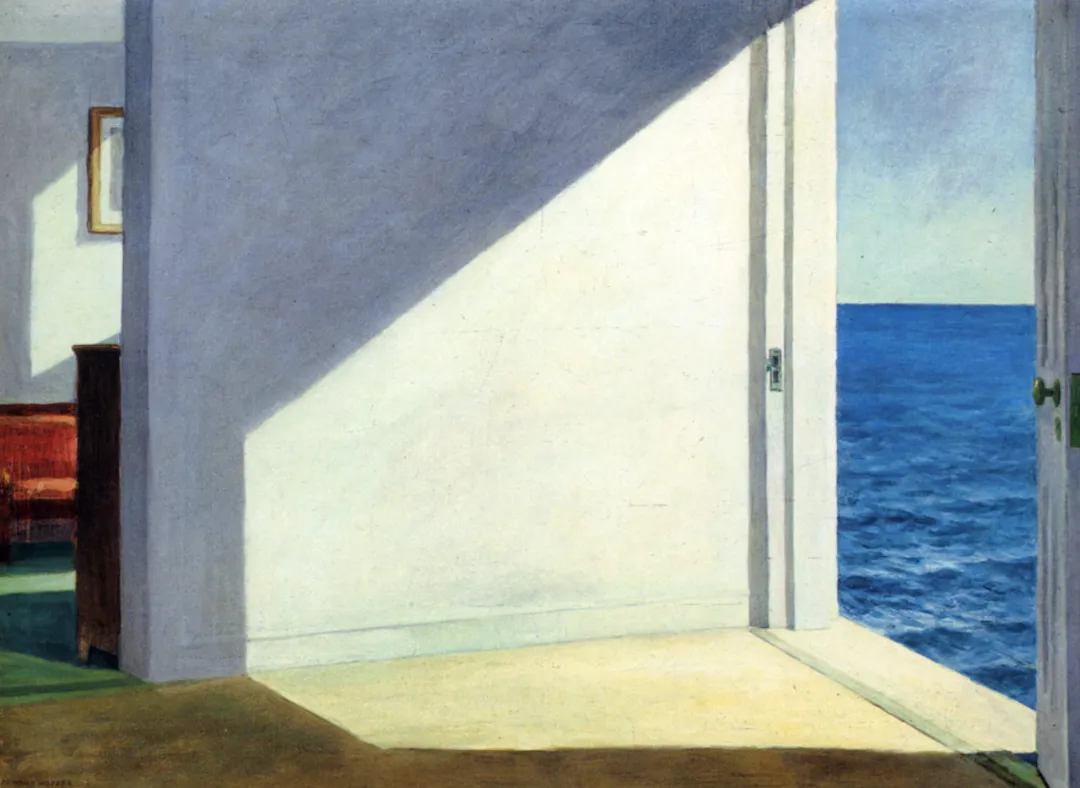
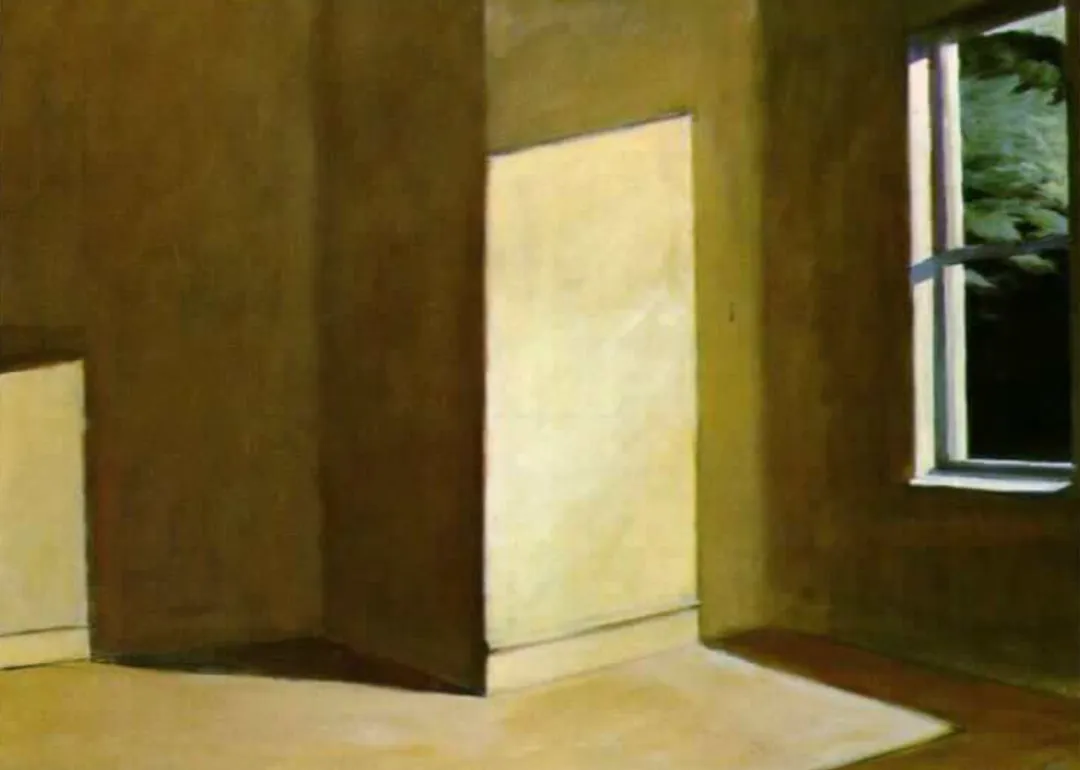
The two images above show the kind of “still life” scenes photography enthusiasts love to photograph: an empty room, or a beam of afternoon light entering through a window. Yet however they are photographed, they seem unable to give us the same sense of loneliness. In Hopper’s paintings, by contrast, we can always feel a certain distance within the most familiar scenes.
“Not here”—this is the strongest feeling I have when looking at his work.
“Not here,” and yet “visible.”
We look at the image as if we were inside it, but a sense of distance constantly reminds the “viewer” that “reality” exists beyond the frame. The viewer thus becomes a thief inside the picture, hiding in an unknown corner and spying on everything that unfolds. Despite the bright sunlight and fashionable interiors, sorrow and loneliness seep from every part of the scene. As we witness them, it is as though we also experience that solitude ourselves.