
HOW I LEARN - Egon Schiele
Egon Schiele’s work is not conventionally beautiful, yet it is difficult to forget. Through twisted bodies, rough lines, incomplete frames, and almost pathological color, he confronts viewers with sexuality, loneliness, life, and death. This essay does not propose that we imitate Schiele. It asks what his Expressionism can teach us about a more primal and direct way of seeing.
I recently picked up the camera and began photographing again, only to feel that I was returning to my old path. Technique is always relatively simple and easy to imitate, but a photographic idea is difficult to acquire. Only through sustained experimentation and repeated challenges to oneself can a new way of seeing gradually emerge. It is difficult, but unavoidable.
For this installment, I chose the Expressionist painter Egon Schiele, an artist I admire greatly. His work also reminds me of Nobuyoshi Araki.
01 - Egon Schiele
Egon Schiele was born on June 12, 1890, in Tulln an der Donau, Austria, and died in Vienna on October 31, 1918. He was an Austrian painter and draftsman closely associated with Expressionism.
Born into a lower-middle-class family, Schiele resisted his family’s wishes and committed himself to becoming an artist. His talent earned him admission to the Academy of Fine Arts Vienna at the age of sixteen. Contact with the Vienna Secession, the Wiener Werkstätte, and Gustav Klimt soon opened new artistic horizons.
At the end of 1909, as his talent became increasingly visible, he founded the short-lived Neukunstgruppe, or New Art Group, with several painters, musicians, and poets. He also wrote lyrical texts of his own.
Within what he understood as his artistic mission, Schiele made the nude his principal field of expression. He depicted adult bodies, including his own, and also produced controversial works involving underage models. In 1912, he was arrested and briefly imprisoned.
Around 1915, he left his partner and model Wally Neuzil and, while other relationships continued, married Edith Harms, a young woman considered more socially “suitable.” Assigned away from the front for health reasons, he continued working during the war. As his pictures began to sell, he gained a measure of financial security.
After Klimt’s death in 1918, Schiele emerged as a leading figure among Vienna’s younger artists. That same year, however, he and his pregnant wife contracted the Spanish flu. Schiele died on October 31, three days after Edith, at the age of twenty-eight.
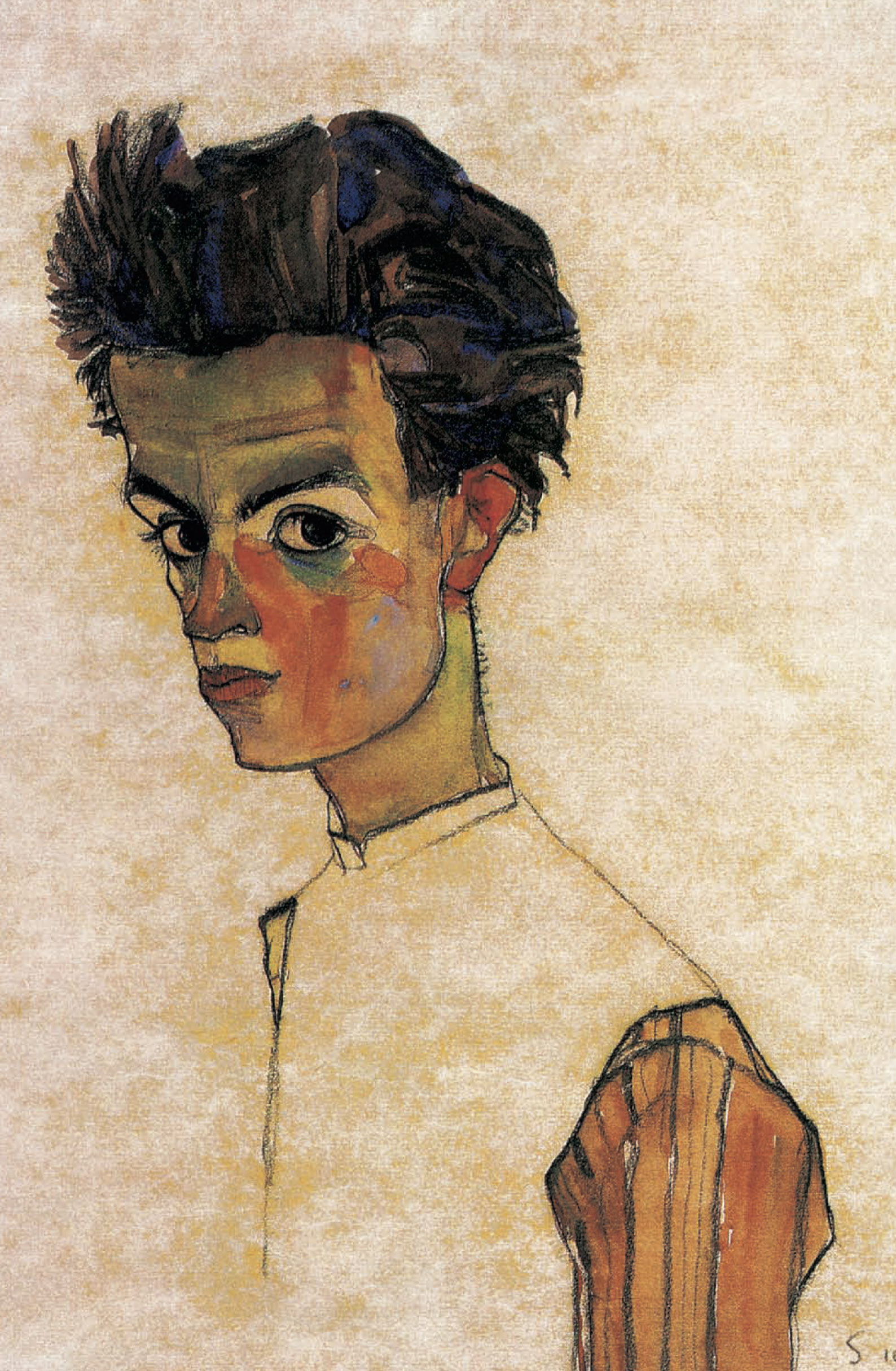
Schiele created roughly 300 oil paintings and more than 3,000 works on paper, often combining drawing with watercolor and gouache. He made still lifes, landscapes, portraits, and allegories, but is especially known for his numerous self-portraits and nudes, some remarkably direct in pose and detail.
Although his line and palette softened over the course of a decade, the work continued to impress through forceful imagery, contrast, and colors that were unrealistic and at times pathological. His thin, dislocated figures, seemingly suspended in empty space, embody sexual and existential anxiety, loneliness, and pain.
Schiele is difficult to place entirely within one group. Standing between Art Nouveau and Expressionism, he abandoned established conventions and expressed his sensitivity in a highly personal form. At the same time, he reflected the disillusionment and latent conflict of a society in decline.
He played an important role in the renewal of Austrian art and received recognition during his lifetime. He was not simply the “cursed artist” of later mythology, permanently confined to the margins. Yet the tension and audacity of his subjects remain startling a century later. As an important modern painter and draftsman, he entered art history and became a point of reference for many artists from the second half of the twentieth century onward.
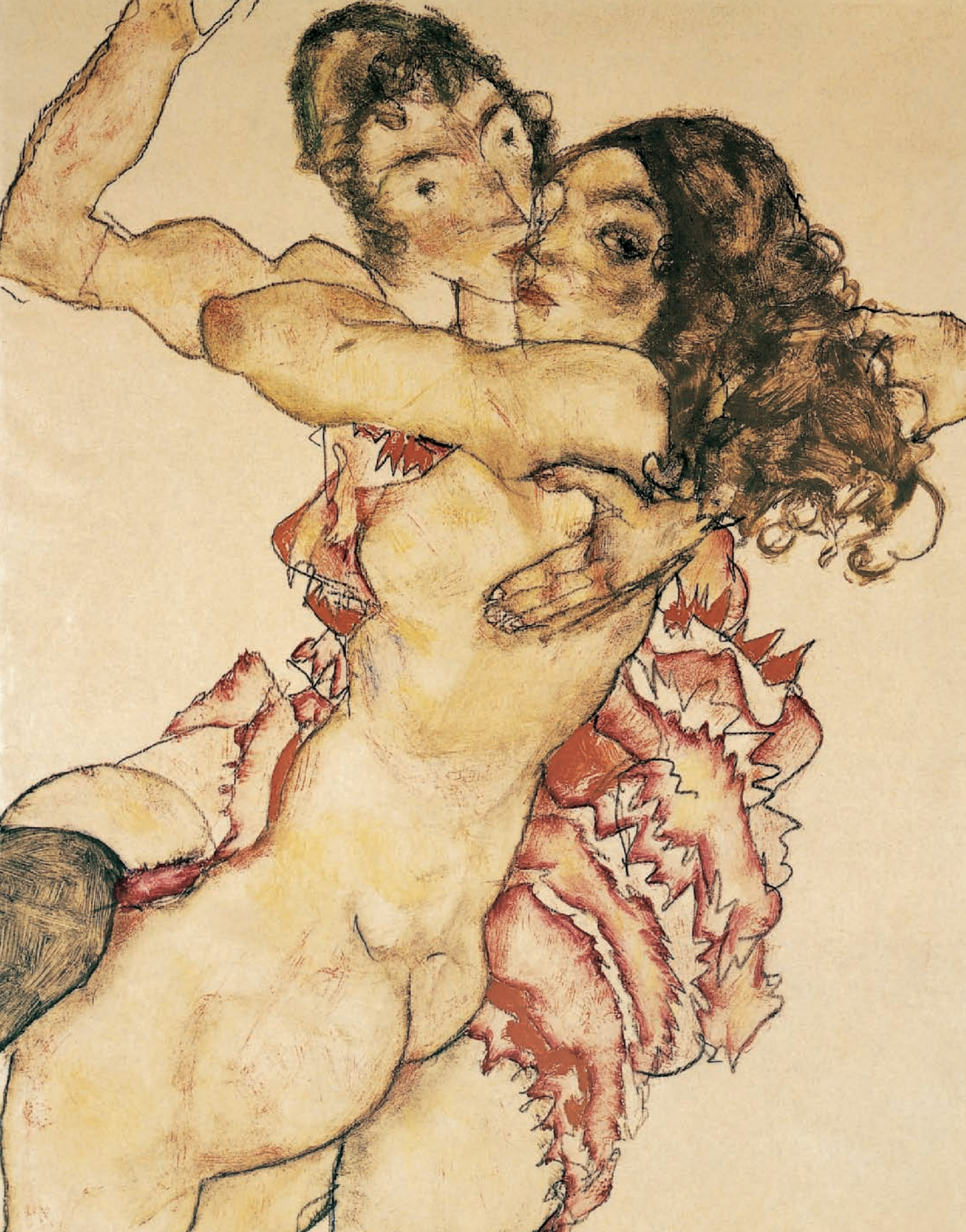
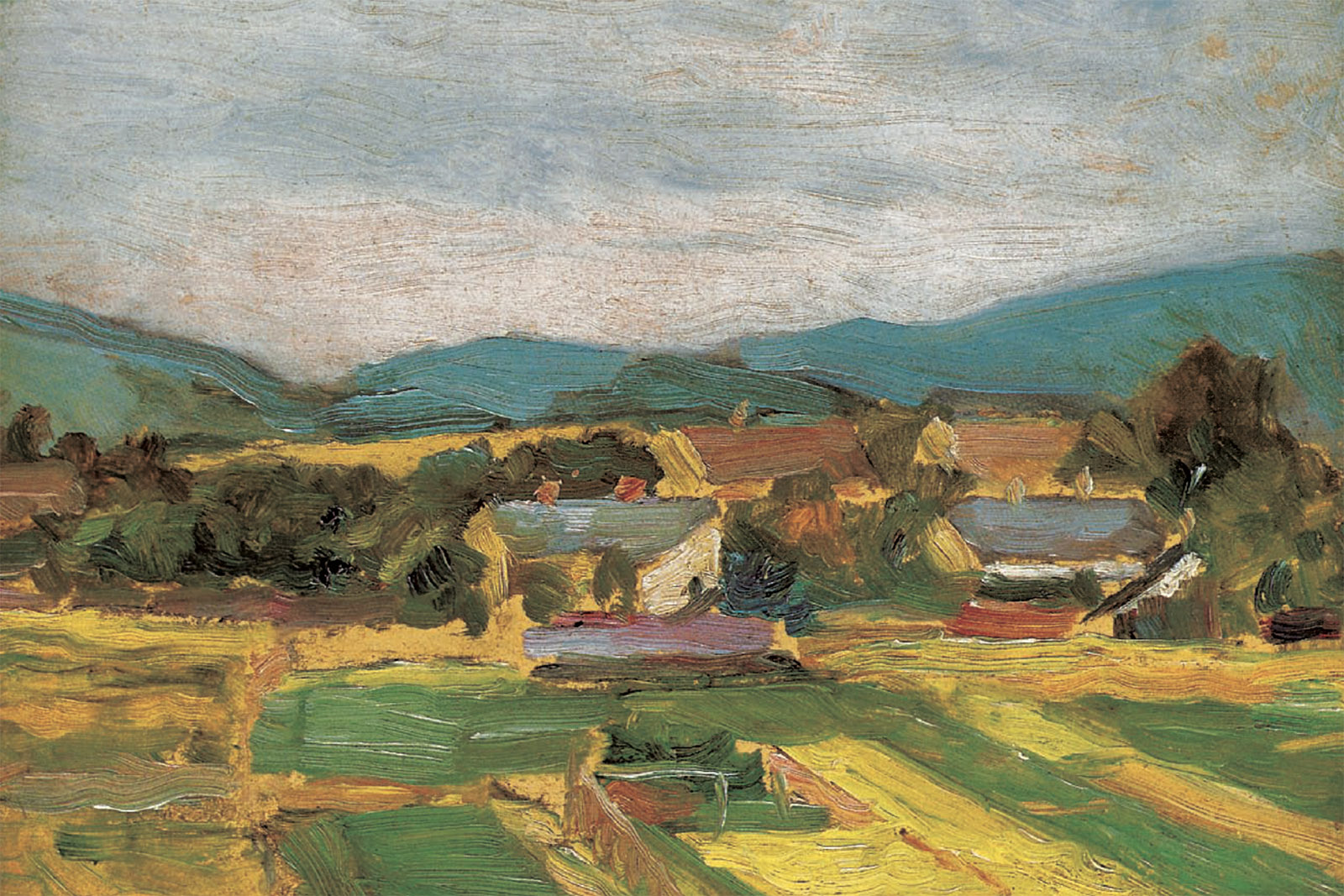
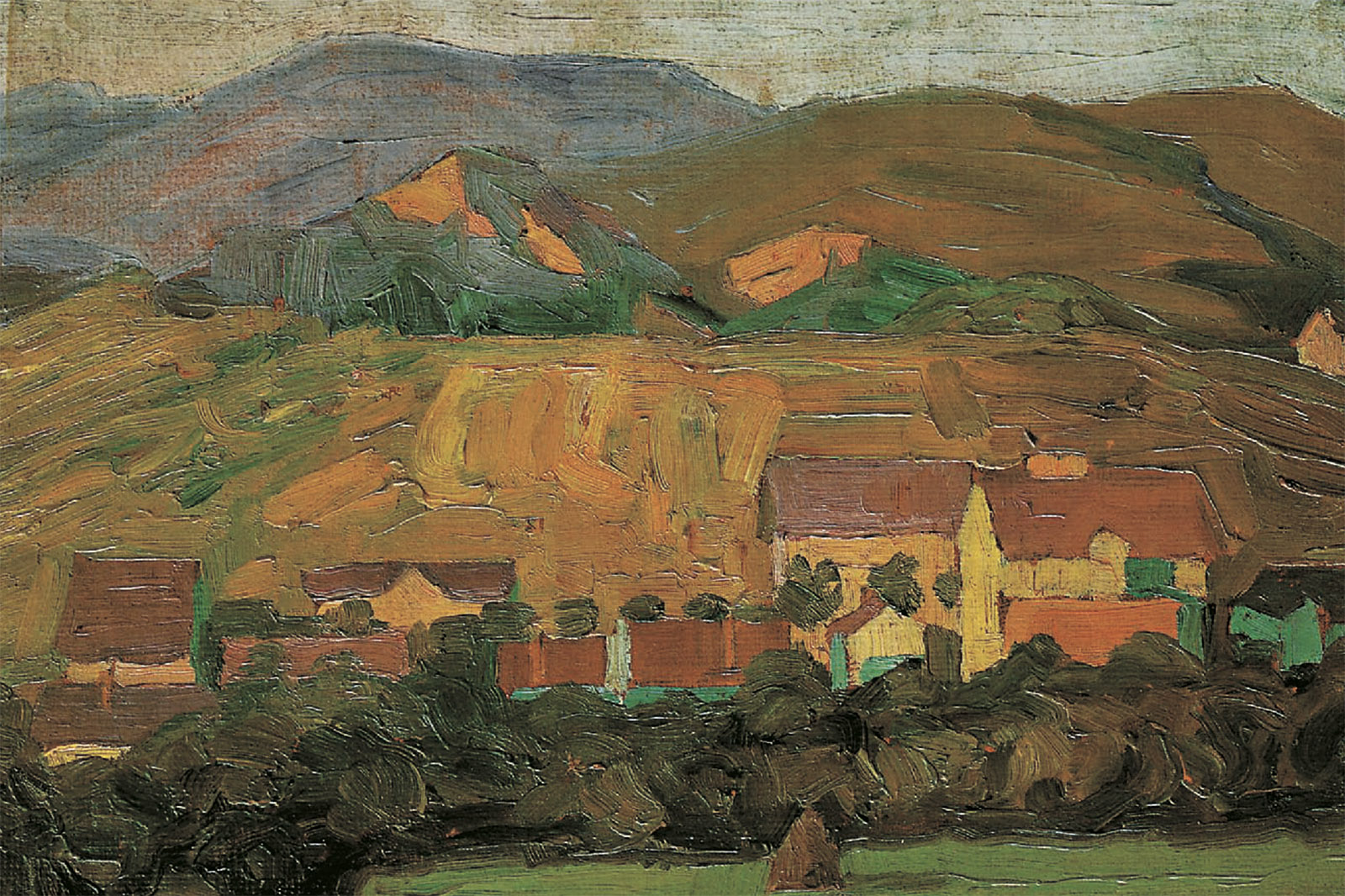
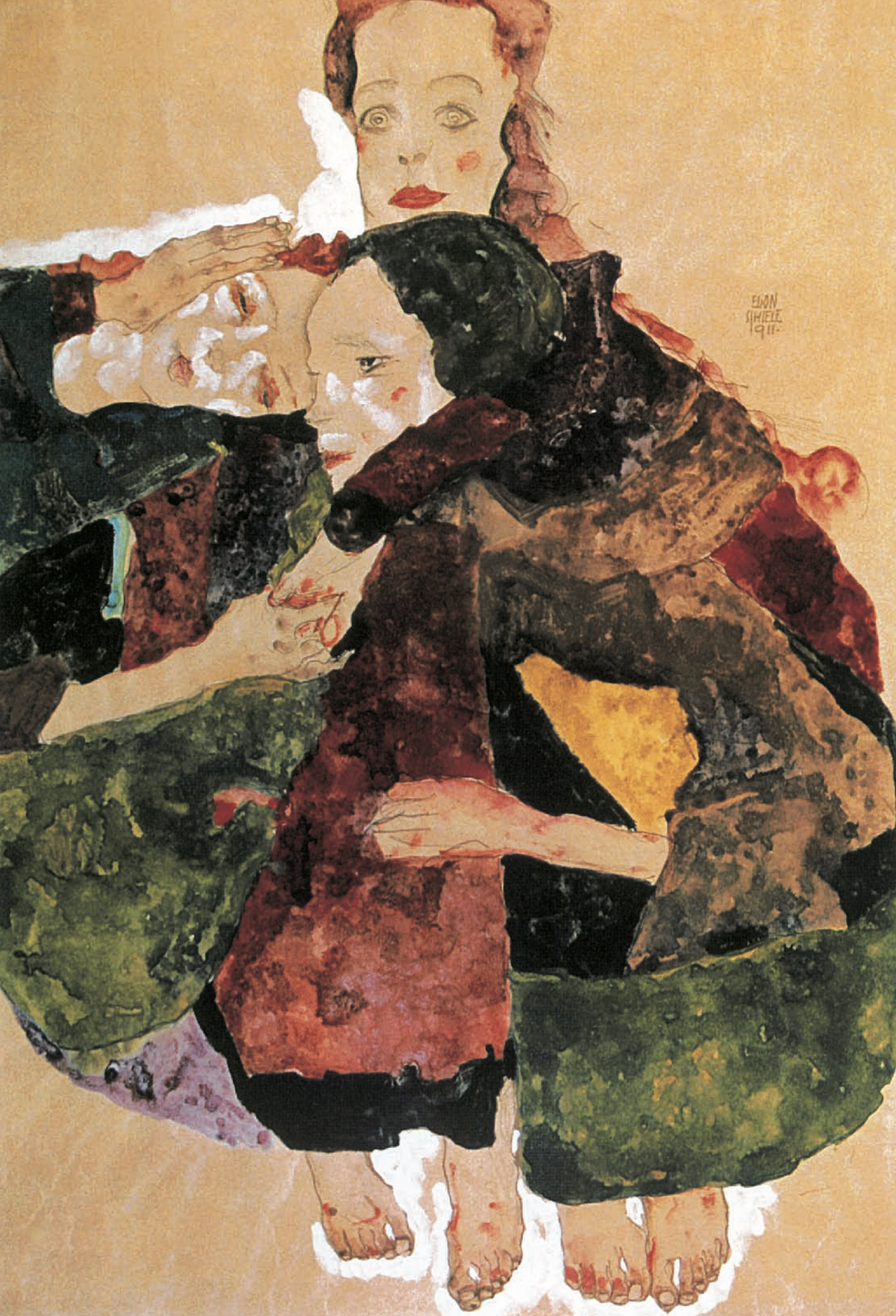
In 1964, Oskar Kokoschka described the first large Schiele exhibition in London as “obscene.” In an age that discovered modern art and lost the traditional “subject,” Schiele responded that modernity did not exist for him; there was only “the eternal.”
Schiele’s world contracted into the portrait: partial, released from a specific time, and offering no promises. Self-discovery became a ruthless exposure of himself and his models. The German encyclopedia of artists compiled by Thieme and Becker described him in sexual terms because his art dealt directly with the desiring body. He studied both male and female bodies. His models display remarkable freedom in relation to gender, narcissism, same-sex desire, and voyeurism, drawing the viewer into the image.
Conventional ideas of feminine beauty did not interest him. He understood that the urge to look was entangled with mechanisms of disgust and seduction, and that the body contained the forces of both sex and death.
In a photograph made on his deathbed, the twenty-eight-year-old artist appears to be sleeping. His emaciated body is utterly depleted, his head resting on a bent arm. Like his paintings, the image is shocking. Because of the danger of infection, his final visitors communicated with him through a mirror placed between his bedroom and sitting room.
In that same year, 1918, Schiele designed a mausoleum for himself and his wife. Did he know death was approaching? Did an artist whose work often seemed prophetic sense that his own fate was merging with the collapse of the Habsburg Empire?
His career lasted barely a decade. He painted figures, still lifes, rural landscapes, and cities, yet became especially famous for his drawings. As Sigmund Freud exposed the repressed desires of Vienna’s upper classes, Schiele used nude studies to confront the body of the model and ultimately forced viewers to face their own desire and their own act of looking.
I do not deny that I have made drawings and watercolors of an erotic nature. But they are always works of art. Are there no artists who have done erotic pictures?
02 - Expressionism
Expressionism was a major artistic movement of the early twentieth century. It emphasized emotion, subjectivity, and individual experience as means of expressing inner life while criticizing and reflecting on the external world. Its influence extended through painting, sculpture, literature, music, and theater.
Expressionist artists used exaggeration, distortion, and unnatural color to communicate inner experience and emotional intensity. They addressed individual feeling, social problems, and fundamental questions of human existence, using art to expose the complexity of life and emotion.
In painting, distorted forms, violent colors, and exaggerated brushwork produced dramatic effects and foregrounded emotional impulses. Expressionist literature often contained inner contradiction, anxiety, and reflection on existence. In music and theater, dissonance and extreme situations served similar purposes.
Overall, Expressionism emphasized feeling, personal experience, and social reality while exploring the complexity of human emotion and existence. It had a profound influence on modern art in the twentieth century.
03 - The Work
My love for Schiele’s work is almost irrational. What I love is not its nudity or sexuality, but the rough, primal force of the human body. That force conveys both basic humanity and a form of primitive wildness. “When people remove the clothing of morality, they too may become animals.” This thought often comes to mind when I look at Schiele.
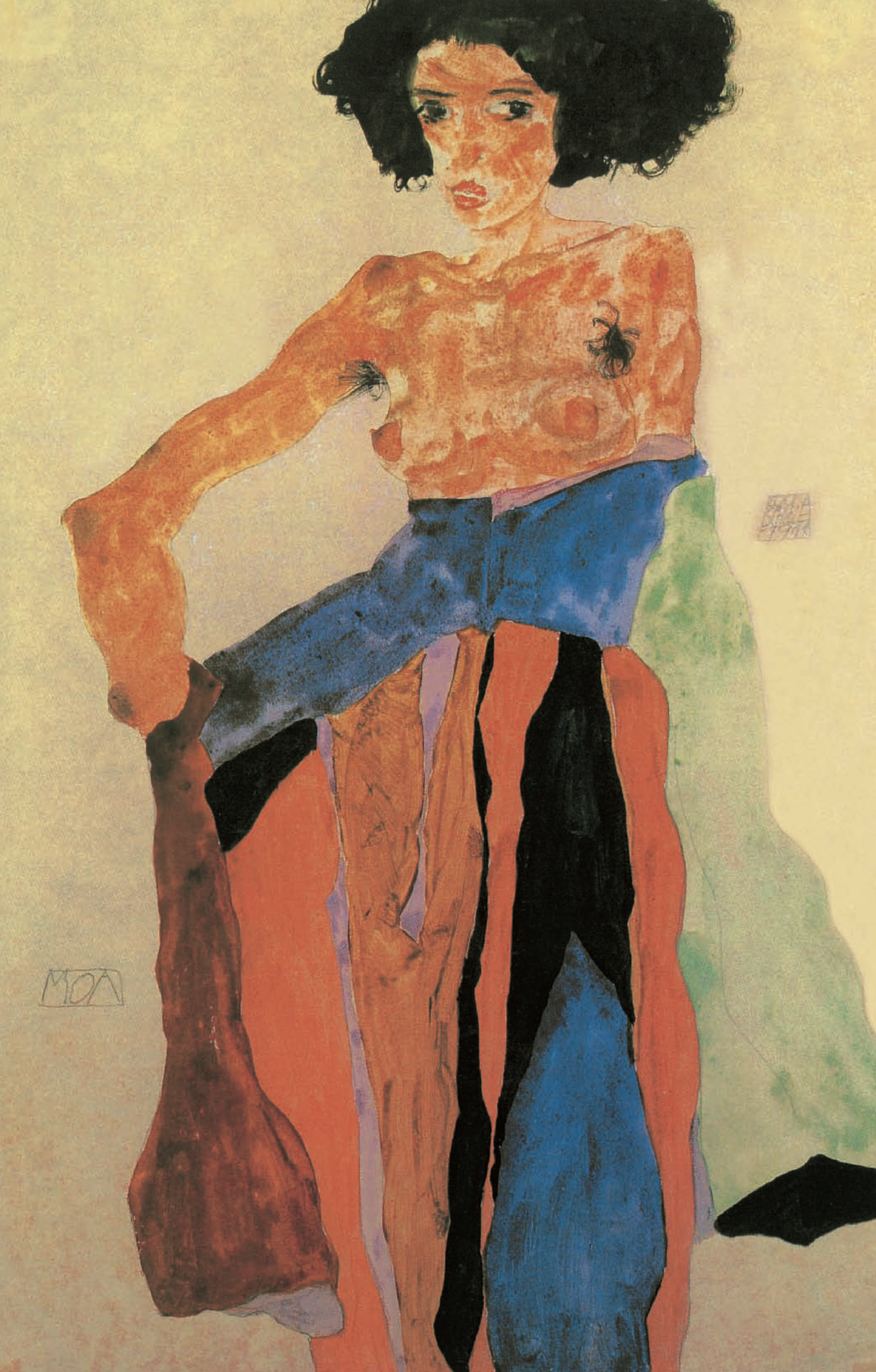
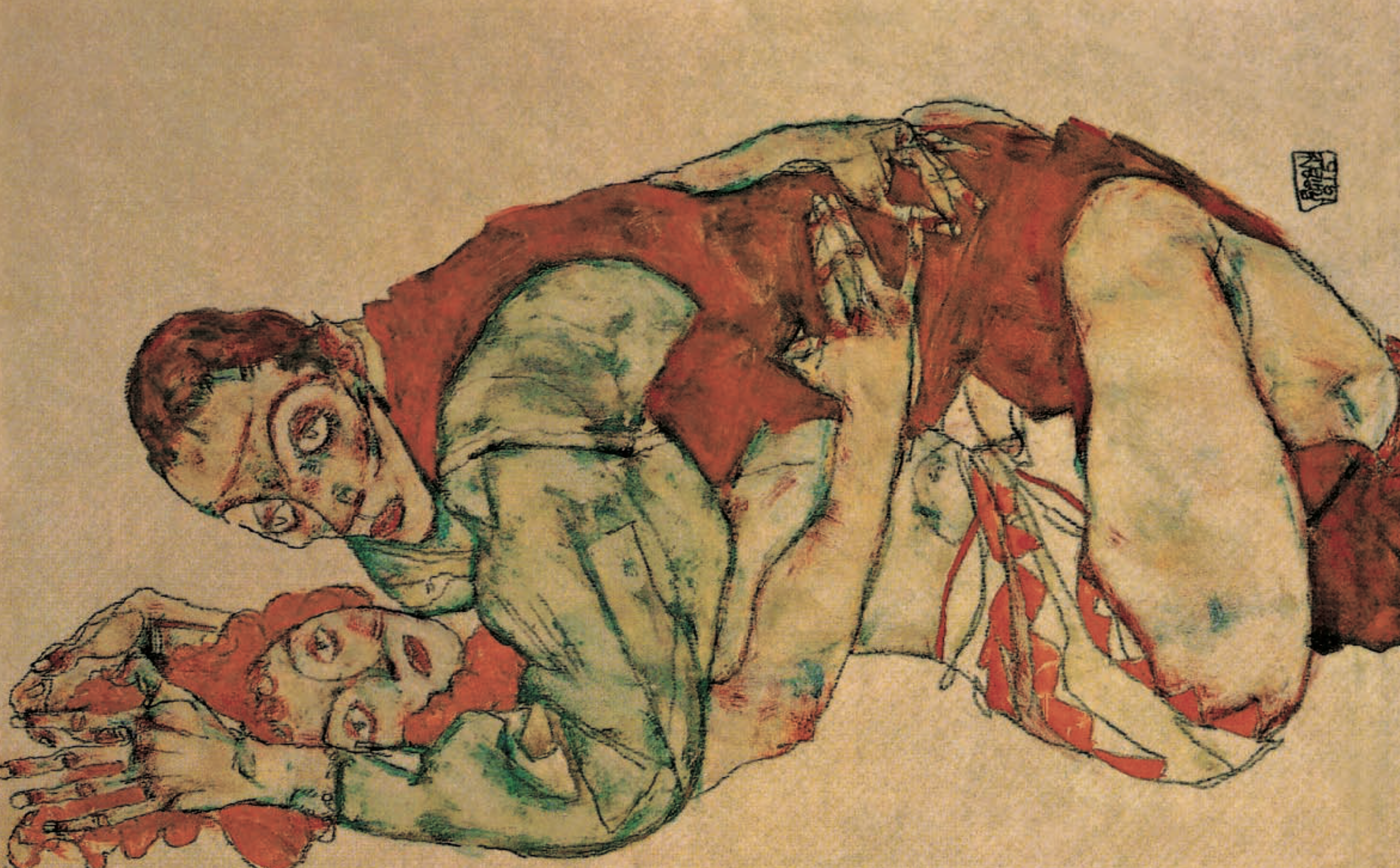
When Schiele painted the nude, he faithfully retained specific bodily features. In this work, for example, he included armpit hair. Within the aesthetic framework of traditional painting—especially the Madonna-like image of woman inherited from the Renaissance—a smooth and pure female body was considered beautiful. Armpit hair therefore appeared vulgar, impure, and rebellious.
Across the image, the hair nearly replaces the breast as the element that first commands attention. Yet the return of a bodily feature removed from traditional imagery creates a powerful emotion. Such ordinary characteristics had previously been treated as abnormal and unfit to appear. The excessive idealization of the body created distance by making beauty seem like a quality available only to gods.
The hair creates a sense of voyeurism, but also a sudden recognition: “So what? Everyone has it.” Divinity returns to humanity.
The woman’s upper body is nude, revealing breasts that do not conform to classical ideals. The lower body appears covered by a skirt or cloth, while an unfinished hand seems to be removing the remaining clothing. Her gaze expresses no dramatic emotion, as though the moment were simply part of ordinary life.
This may not be Schiele’s most forceful picture, but its primal quality, roughness, incompletion, and color all carry his unmistakable style. Whether or not we like it, we remember it.
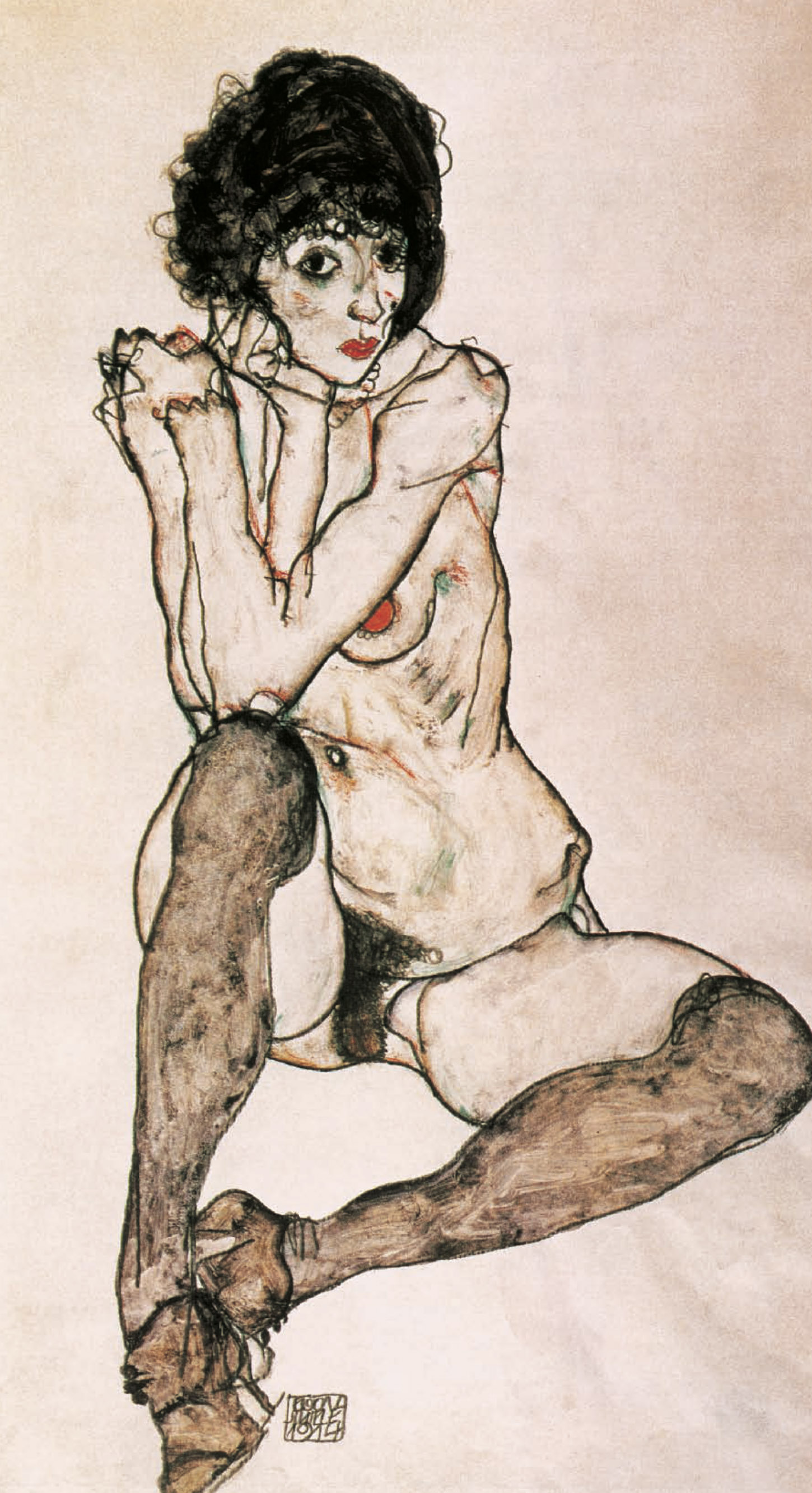
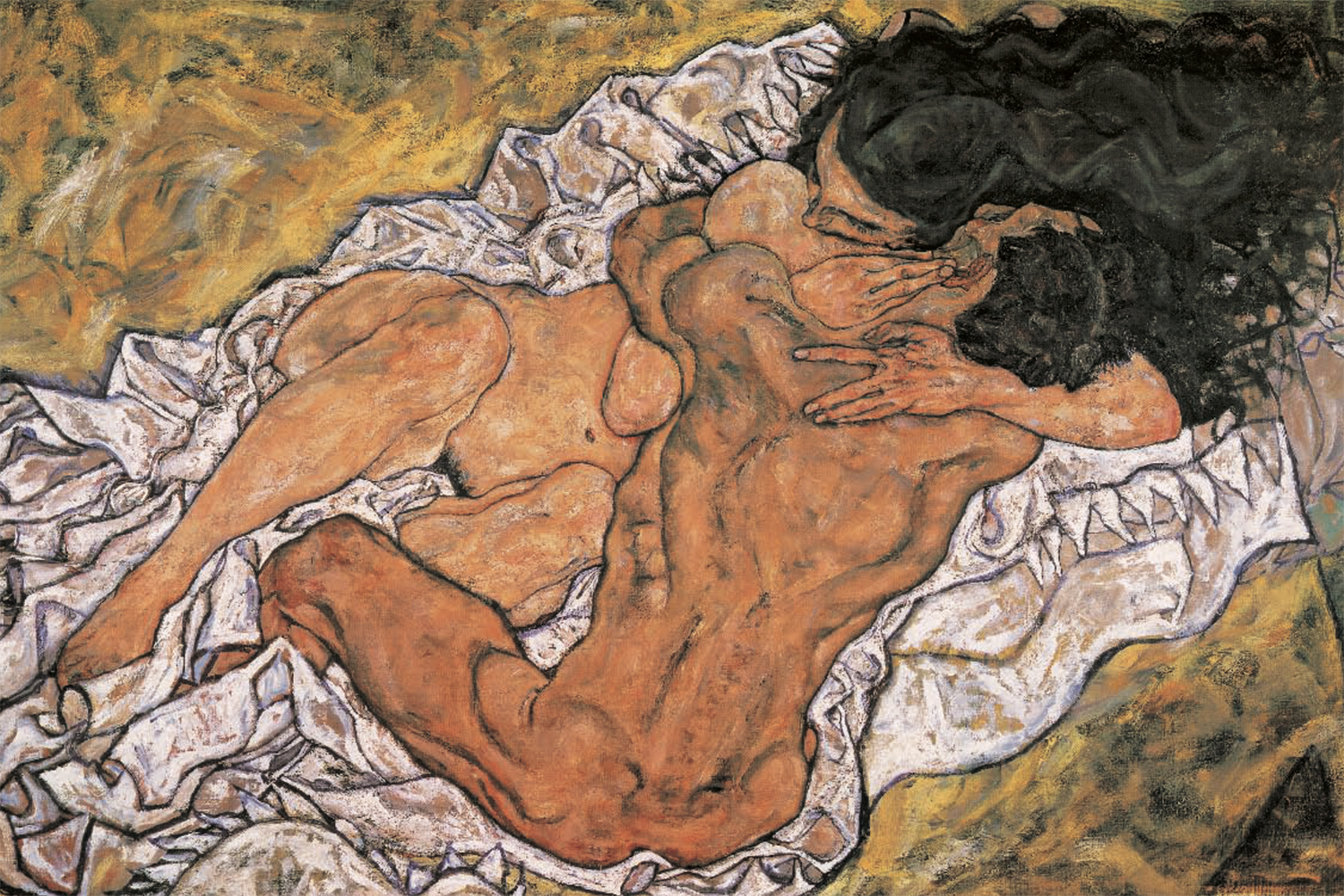
This is a characteristic Schiele nude, again rough and incomplete. At first, the line seems crude and savage, yet its overall flow is remarkably fluid. The movement and muscular structure are also precise.
Schiele’s “incompletion” often appears in the refusal to fill the entire frame. The figure alone is emphasized, while background and decoration are almost completely discarded. Color is similarly applied only to important areas. Everything else is abandoned. To many viewers, these works resemble sketches, yet adding anything would feel superfluous.
The picture again conveys the primal, rough, and savage. We see the woman’s breasts immediately, but they are not idealized objects designed to create desire. Below them, bones show through a thin abdomen, making the model appear emaciated and unhealthy. The lower body is exposed with almost careless directness, producing little conventional beauty or erotic pleasure. Rather than existing as an image for sexual stimulation, it communicates something primal, savage, vulgar, and impure.
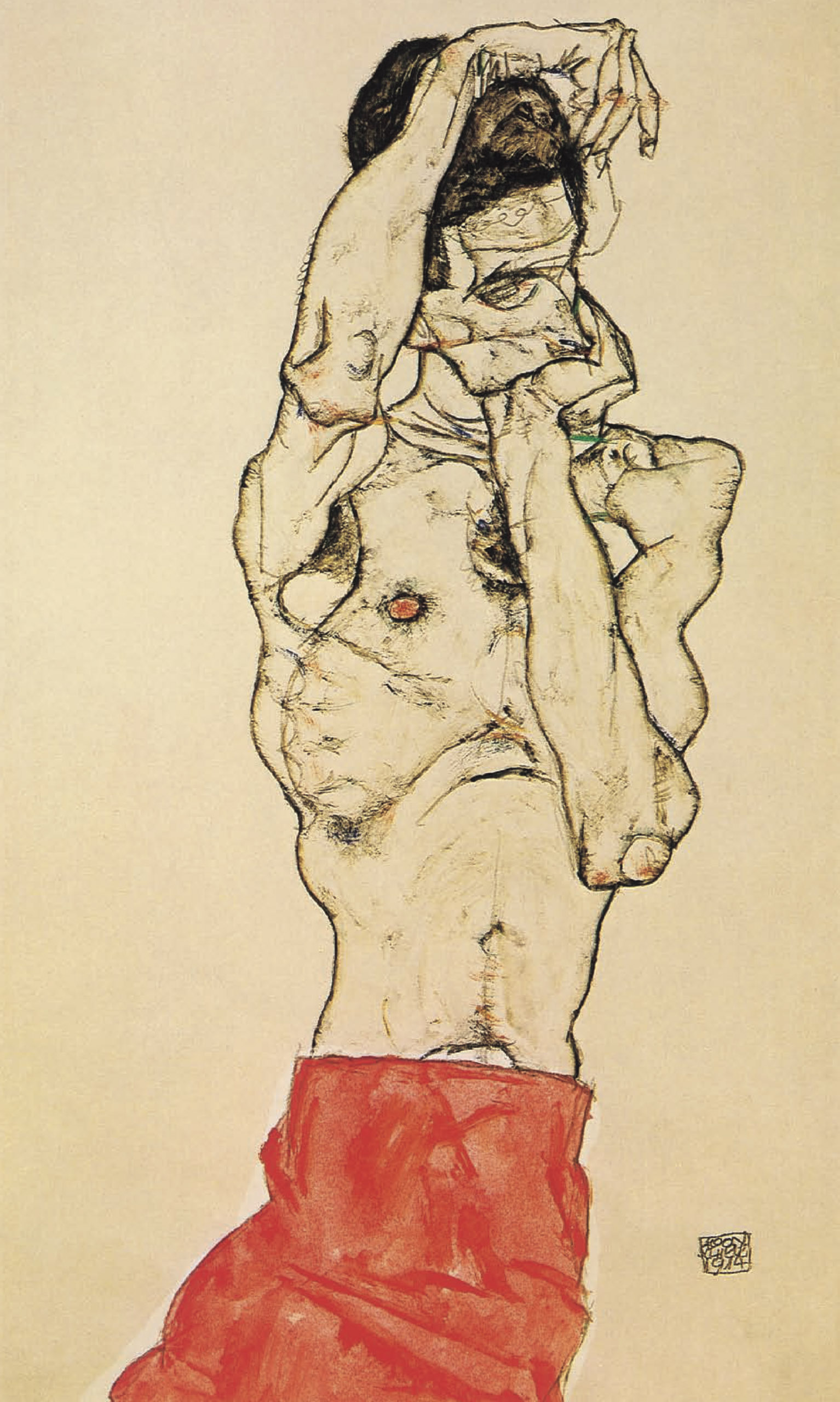
This work likewise emphasizes savagery, vulgarity, and incompletion. Its vivid red produces a strong sense of life, while the man’s upper body is twisted and unnatural. This unnatural wildness merges with nudity to create an emotion that is complex, distorted, and primal, suggesting life and death at once.
At present, I am mainly observing the physical motion of mountains, water, trees and flowers. One is everywhere reminded of similar movements in the human body, of similar impulses of joy and suffering in plants.
04 - Life and Experience
In 1908, Schiele participated in his first public exhibition in the Imperial Hall of Klosterneuburg Abbey, showing small landscapes made from summer through autumn. According to scholar Jane Kallir, by the end of 1908 he had already completed nearly half of the oil paintings he would produce in his lifetime. His art underwent a major change in 1909.
He left the academy and its conservative professor Christian Griepenkerl and founded the Neukunstgruppe with artists including Anton Peschka, Albert Paris von Gütersloh, Anton Faistauer, Sebastian Isepp, and Franz Wiegele. Resistance was central to the group’s spirit.
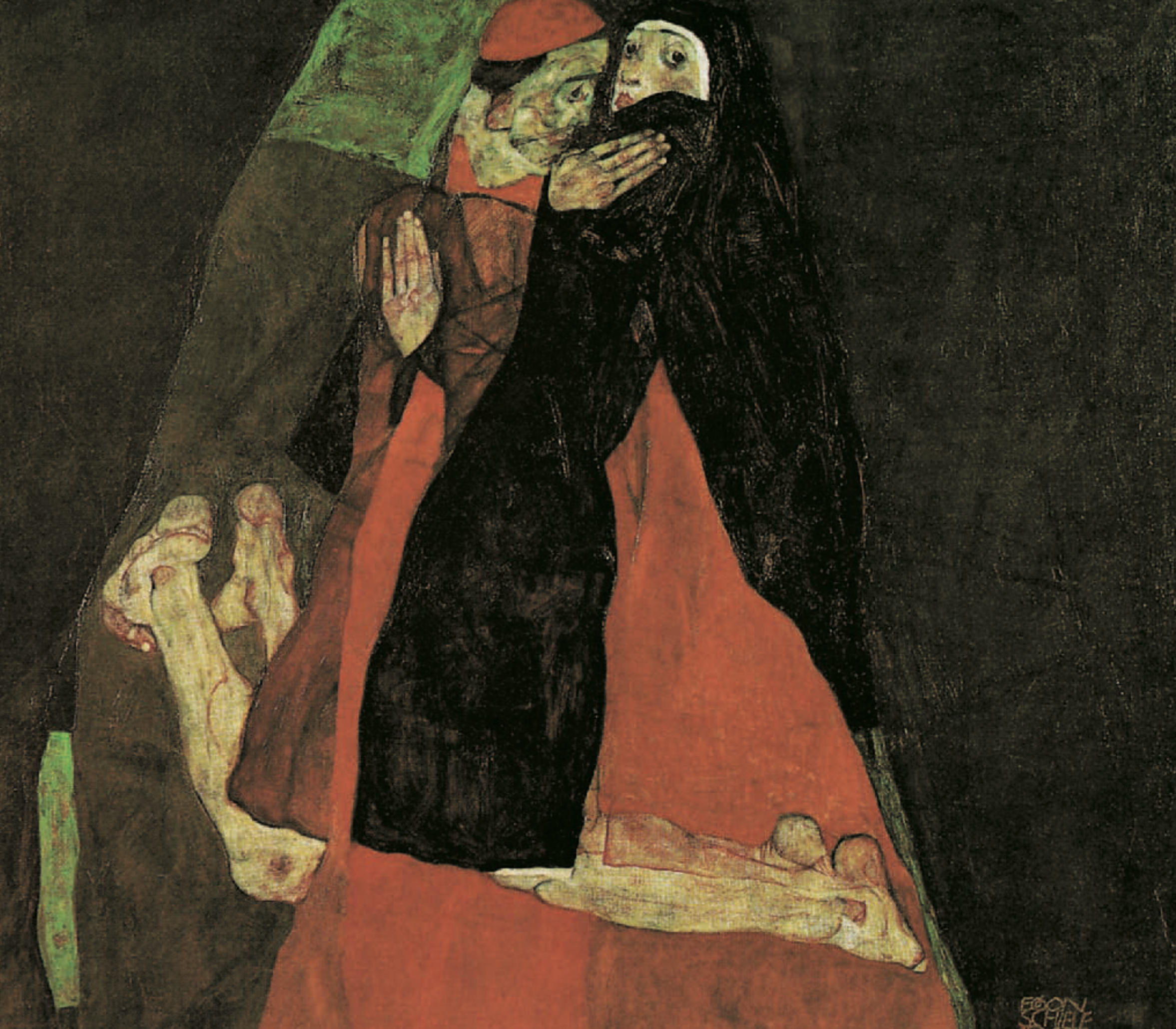
Schiele’s emphasis on subjective experience was a response to Viennese historicism and Hans Makart, the painter championed by the government. He distanced himself from allegorical composition, overturned traditional Catholic values, and redirected their symbols toward desire. His strategy was to create shock. In The Red Cardinal, Schiele lies back in an orange shirt with his abdomen exposed and legs spread, while a nude blonde woman faces the viewer in the foreground. Religious pose and erotic meaning collide within one image.
Other pictures included monks, nuns, pregnant women, and same-sex couples, breaking taboos in Viennese society and provoking the viewer’s imagination. Schiele gained recognition at the International Art Exhibition in Vienna, where his work appeared alongside that of Vincent van Gogh, Edvard Munch, and Oskar Kokoschka. He also met Josef Hoffmann, a leading figure in the Wiener Werkstätte. The Neukunstgruppe held its first exhibition in December 1909.
The difference between Schiele’s handsome appearance and his repellent, ugly self-portraits was astonishing. Gütersloh described him as exceptionally handsome, meticulously groomed, and elegant in manner—a striking contrast to the notorious style of his pictures. In his self-portraits, however, Schiele became a long face with a high forehead, large eyes sunk into their sockets, and an expression of pain. His body was thin, sometimes mutilated, with spider-like limbs. Weak hands carried the presence of death, his body took on decaying colors, and his face often resembled a skull. In a poem, Schiele admitted: “Everything is living death.”
Schiele also saw himself as a suffering man: “I say only that I am true, because I sacrifice myself for others and for myself and must live the life of a martyr.” As modern art pushed traditional religious subjects from view, artists began to embody these figures themselves.
In a letter to Arthur Roessler, Schiele gave himself an even more Christ-like role: “I sacrifice myself for others, for those I pity, those far from me, and those who do not see me.” As an outsider, he imagined the artist as a redeemer of the world.
For him, a work was no longer an illustration of a story but an expression of the soul’s inner life. The nude study became revelatory research, and through expressive self-performance, the work became a study of his own life.
Fascination with Death
Turn-of-the-century Viennese culture was fascinated by death and idealized the “beautiful corpse.” The poet Georg Trakl wrote that all becoming seemed diseased and met his own death in the context of the First World War in 1914.
Schiele, too, became interested in illness and pathological imagery. At the clinic of gynecologist Erwin von Graff, he studied and drew sick and pregnant women, newborns, and stillborn infants. He was fascinated by the suffering experienced by the innocent and observed skin, blood vessels, eyes, mouths, and the soul contained within the vessel of the body.
In this respect, he resembled Kokoschka, who was called a “ripper of souls.” Kokoschka seemed to strip away a subject’s appearance in paint until only a spiritual skeleton remained. In his play Murderer, the Hope of Women, red signifies life and white signifies death; man and woman stand upon a stage of life and death.
Phantomlike Depiction
Schiele outlined bodies on paper with only a few strokes, sometimes describing a thigh with two lines. His marks are dynamic and gradually fade, using rapid movement to establish structural form. He favored the skeleton, describing it through zigzags and sharp angles.
The line behaves like calligraphy, capturing bodily expression through brief marks. Contracted shoulders and pelvis and an emaciated appearance contrast with rounded, projecting breasts. Orange nipples and genital areas resemble wounds.
The faces of his models often remain anonymous and phantomlike. Their flat eyes resemble those of dolls and could belong to anyone. The body is directed toward the viewer’s gaze and exposes itself. Open hands are strange and rigid, recalling the hands in Schiele’s self-portraits.
Death from Influenza
After Klimt’s sudden death and Kokoschka’s exile, Schiele became one of Vienna’s most prominent artists. At the 49th Vienna Secession exhibition in 1918, he showed nineteen large paintings and twenty-four drawings.
Franz Martin Haberditzl acquired Portrait of the Artist’s Wife for the Moderne Galerie. It was the first painting by Schiele to enter a museum collection during his lifetime. The institution, however, considered the checked skirt indecent and required him to alter it.
Schiele could now afford a larger studio and planned to turn the old one into an art school. As early as 1917, he had imagined an arts center in which literature, music, and visual art would coexist, with figures such as Schoenberg, Klimt, and the architect Hoffmann among its participants.
Death stopped these plans. Three days after his wife, six months pregnant, died, Schiele succumbed to the Spanish flu on October 31, 1918.
Three days later, on November 3, Austria-Hungary signed an armistice.
05 - What We Can Learn from a Master
Schiele’s behavior and way of seeing may be described as pathological, but there are still things to learn from him. If we do not share his interest in sexuality, life, birth, and death, there is no reason to imitate him directly.
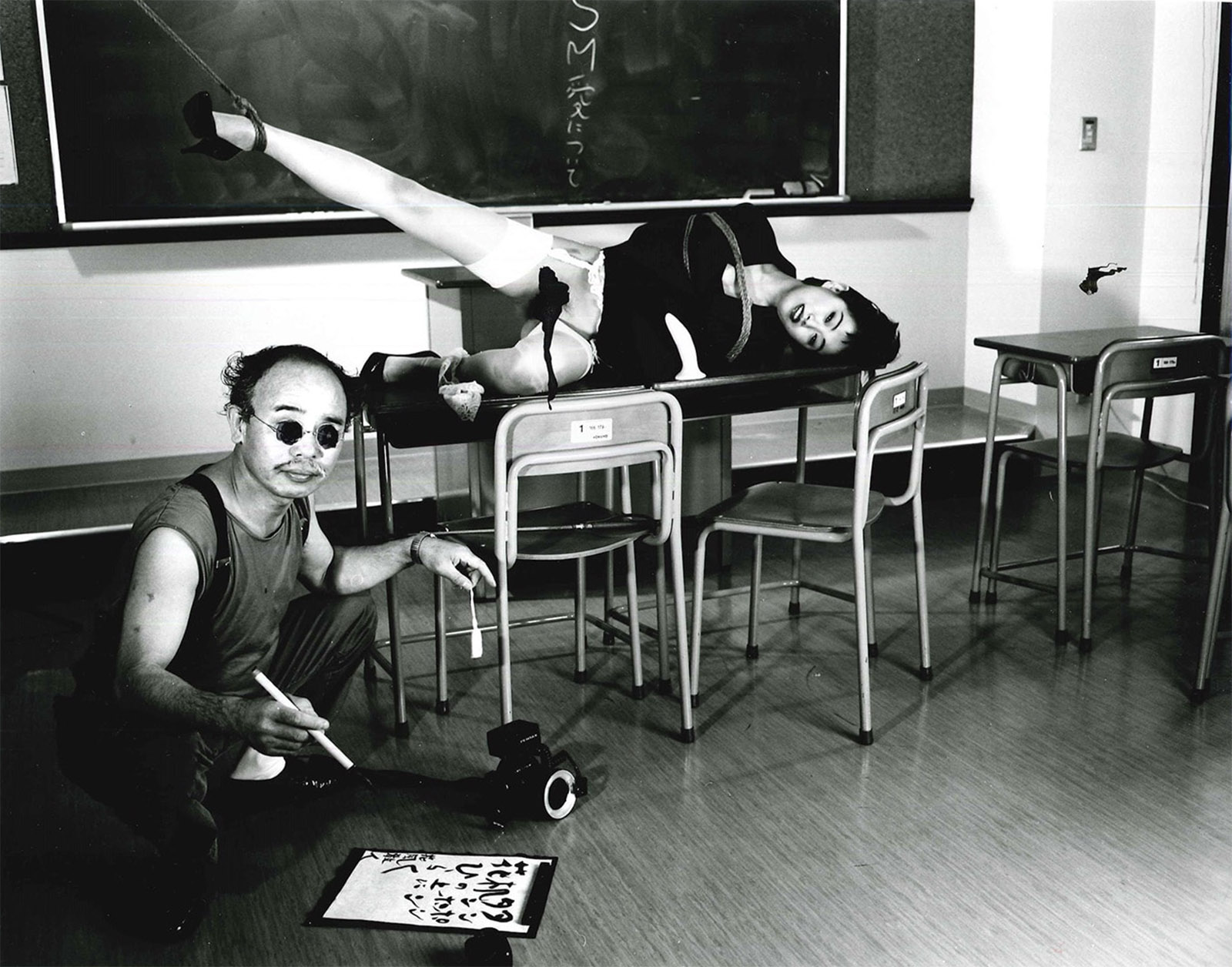
From another perspective, Schiele’s fascination with sexuality resembles Araki’s, although their media differ.
Reveal the Primal
Viewed only within the frame, Schiele’s pictures often appear incomplete and unfinished, more like sketches. Yet this incompletion heightens their primal quality. They look rough and unconsidered, while their details reveal certainty. The line moves from solid to faint and from thick to thin, full of movement.
Schiele ignored the conventional effects of light and shade used to model the body, employing marks that dissolved spatial limits. In his studio, he often stood on a ladder and captured models from an extreme bird’s-eye view, observing them from above and below. He isolated these beings within his field of vision and placed them in a world without time or location. The body itself formed space, while the subject’s position seemed to lose all orientation.
Schiele did not “fill” the image as Renaissance painting traditionally did. Filling a scene generally required complete bodily detail, correct perspective, and an environment that explained the relationship between figure, setting, and historical period. Schiele discarded that completeness and retained only the central presence that needed to be seen.
Color was likewise applied only to the areas demanding attention; the remainder stayed blank, leaving the viewer an open imaginative space. This emptiness is not created by critical exaggeration, but by the chemistry between line and selective color.
Schiele also made relatively finished pictures, yet in the expressive power of the central figure they often fall short of his unfinished “sketches.”
Bodies have their own light which they consume to live: they burn, and they are not lit from the outside.
From the perspective of photography, we can likewise work in a more primal manner and reveal a rough, direct force.
Attractive Is Not the Same as “Beautiful”
For many people, attractiveness represents beauty. Within contemporary art, however, what is attractive is not necessarily what is beautiful. Contemporary practice has moved beyond traditional definitions of visual pleasure and emphasizes diversity, reflection, social meaning, and conceptual expression.
- Conceptual aesthetics: Beauty lies in the ideas, meanings, and processes behind the work rather than its appearance alone
- Emotional and expressive aesthetics: Art explores emotion and inner experience, as Expressionism foregrounds the artist’s own affect
- Social and political relevance: Art engages social issues and uses creative expression to articulate a position toward reality
- Fragmentation and plurality: Objects are dismantled and recombined to explore the beauty of collage, materials, abstraction, and multiplicity
- Imperfect beauty: Flaws, incompletion, and provisional states become parts of beauty
When first encountering Schiele, most viewers will not consider the work attractive, but they will remember it. It may appear crude or incomprehensible.
We should nevertheless remind ourselves that a work capable of moving us or remaining in memory may possess a form of beauty without conforming to traditional beauty. That thought alone can change how we see and understand art.
I was in love with everything—I wanted to look with love at the angry people so that their eyes would be forced to respond, and I wanted to bring gifts to the envious and tell them that I am worthless.
The Distinctive Is Stronger Than the Ordinary
In artistic creation, the distinctive is often stronger than the ordinary, even when it provokes discomfort. Street photographer Bruce Gilden, for example, works at close range with flash. His method can be aggressive, but his images are memorable and difficult to dismiss.
When evaluating art, we can first confront the work itself, then discuss the method of creation, and finally the ethics of the artist. Different cultures will, of course, disagree about this order.
Nobuyoshi Araki also depicts sexuality with great directness and has faced public allegations from models concerning his conduct. If we limit the discussion to the work, however, his nude photography contains a primal desire that exceeds pornography based only on explicit exposure.
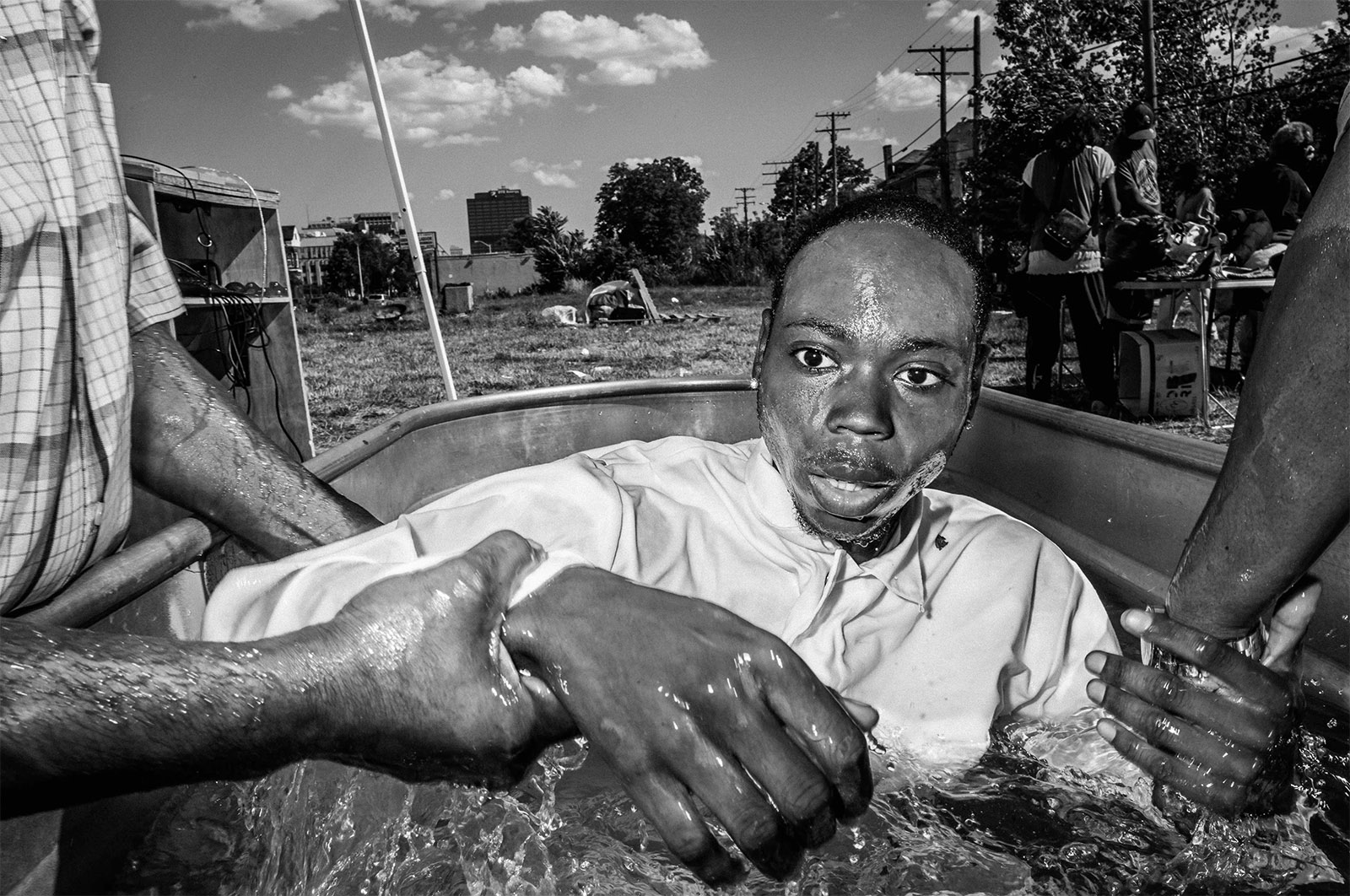
A work first remains in the viewer’s memory. That memory creates interest, prompting the viewer to learn the story behind it and begin studying. Through learning, viewers gradually form their own understanding, produce new concepts, and participate in completing the work of art.
Whether they like it or not, this sustained act of looking and understanding is more meaningful than glancing past something that is merely “ordinarily excellent.”
06 - Conclusion
Although this installment studies the Expressionist painter Schiele, it also offers several lessons for photography.
- Use the primal and the rough: Unpolished expression can heighten primal force. Black and white, blur, camera movement, and incomplete settings can reveal the unusual within the ordinary
- Attractive is not the same as beautiful: Contemporary art defines beauty broadly, and an idea can itself be beautiful. Photography need not show only pleasant things; truth, pain, and conflict may also become forms of beauty
- The distinctive is stronger than the ordinary: A work that stays in memory and encourages viewers to learn and form their own understanding may matter more than something conventionally accomplished
Related Materials
Book
- Egon Schiele by Jeanette Zwingenberger